Below the Surface: How Integrated Sealing Protects Marine Technology
Underwater technology is going deeper, operating longer and taking on increasingly sophisticated work.
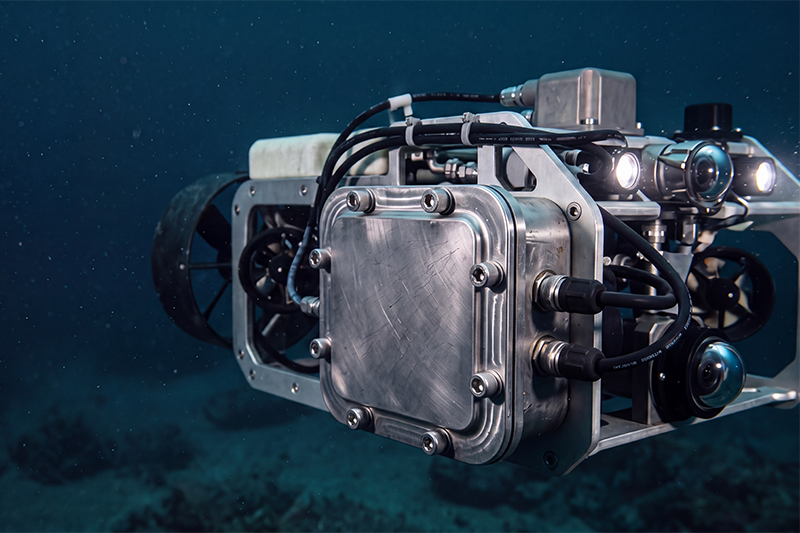
Underwater drones and other subsea vehicles are expanding the possibilities for ocean exploration, inspection and data collection. From systems that survey the ocean floor to underwater sensors, lighting and renewable-energy equipment, these technologies must operate reliably for long periods in and around water.
For engineers designing these systems, the challenge is not simply keeping equipment dry. Marine systems must maintain enclosure integrity against saltwater, corrosion and pressure over extended periods. That requires protecting the enclosure and every opening and connection point against water and contaminants.
Protecting equipment under pressure
Traditional fasteners perform a straightforward mechanical function: holding components together. But when a fastener penetrates an enclosure, that can create a pathway through which water, moisture and other contaminants enter.
That risk becomes more consequential underwater. Saltwater can accelerate corrosion, while increasing pressure places greater demands on seals and enclosure interfaces. Equipment designed for extended underwater operation must maintain protection against those conditions continuously, not simply survive occasional exposure to water.
Sealing challenges also work in the opposite direction. Marine systems containing hydraulic fluids, oils or other chemicals must prevent substances from escaping into the surrounding water, where leakage can damage sensitive equipment and the marine environment.
This makes every penetration part of the overall containment system.
ZAGO Manufacturing's self-sealing fasteners combine the mechanical function of a conventional fastener with an integrated sealing element. A precision-molded rubber O-ring sits within an engineered groove beneath the fastener head. As the fastener is installed, the O-ring compresses to create a 360-degree seal at the point of penetration.
Rather than relying on separate washers, gaskets, sealants or thread tapes, the sealing function becomes part of the fastener itself, helping prevent liquids from entering or escaping at the connection point.
Supporting enclosure-level protection
For equipment designed to operate in or around water, Ingress Protection (IP) ratings provide a standardized way to evaluate how effectively an enclosure protects against solids and liquids. Importantly, an IP rating applies to the complete enclosure or assembly—not to an individual component.
That means protection is only as reliable as the potential pathways into the enclosure. Even when seams and other interfaces are properly protected, fastener penetrations can create points of ingress.
By incorporating sealing directly at these connection points, self-sealing fasteners can help engineers maintain enclosure integrity and support the system-level protection required for demanding marine applications.
Familiar components, critical protection
Protecting sophisticated marine technology does not always require complicated fastening systems.
Marine manufacturers commonly use familiar configurations such as socket head seal screws and Phillips flat head seal screws. What distinguishes these components is the integrated sealing function that allows the fastener itself to help protect the enclosure at every penetration point.
For underwater drones, navigation systems, sensors and other marine equipment, this means a relatively standard component can serve two essential functions: mechanically securing the assembly while helping maintain the environmental integrity of the enclosure.
Designing protection into every connection
As underwater systems become more autonomous and sophisticated—and are expected to operate deeper and for longer periods—the reliability of individual connection points becomes increasingly important.
A highly engineered enclosure can only perform as intended when its individual interfaces maintain that same level of protection. That means looking beyond enclosure walls and seams and considering every place where the barrier is penetrated.
Integrated sealing turns the fastener from a potential vulnerability into part of the environmental protection strategy. By building sealing directly into familiar components, engineers can reduce potential leak paths, simplify assemblies and help protect critical equipment against water, corrosion, pressure and prolonged subsea exposure.
The deeper technology goes, the more consequential its smallest components become. And when every connection counts, ZAGO delivers.
Did You Know?
ZAGO is a purpose-driven company that is committed to the triple bottom line strategy of "People. Planet. Profit."

 English
 Deutsch
 Français
 Italiano
 Español
 SHIPPING